Hull began his radio career accidentally while serving in the military during the Korean War. Stationed in North Africa, he walked past an Armed Forces Radio studio and asked how to get on the air. He was handed a script written in German.
Speaking no German, Hull faked the words, creating a chaotic comedy routine that became a massive hit with listeners and military brass alike.
After honing his frantic, sound-effect-heavy style at smaller commercial stations across New Mexico, Ohio, Florida, and Detroit, he arrived in Los Angeles in 1963.
Joining Pasadena-based KRLA as one of the famous “Eleven-Ten Men,” he was widely known by his on-air moniker “The Hullabalooer,” and his ratings quickly skyrocketed.
Hull’s growing popularity prompted a young female fan to write and record a 1964 song titled Dave Hull The Hullabalooer, which reached the local top 40 charts by early 1965.
Hull was so popular among SoCal teenagers that Baskin-Robbins even named a temporary ice cream flavour after him: “Hullabaloo Orange”.
Dave Hull was a central figure in LA’s relationship with The Beatles, and his influence during the British Invasion was unmatched.
He served as the official KRLA Beatles Fan Club president, routinely using his slot to broadcast exclusive band updates.
He also secured a secret deal with Capitol Records, allowing KRLA to play new Beatles singles before any other station – until rival station KHJ threatened legal action.
He became close with the Fab Four during their 1965 and 1966 American tours, recording approximately fourteen interviews with the band.
Though Hull is synonymous with KRLA, he was a fixture across the Los Angeles dial for decades, hosting prominent shifts at KFI, KGBS, KMPC, and KHJ.
In 1971, he became the first guest host to fill in for Casey Kasem on the nationally syndicated “American Top 40” countdown.
In his heyday, Hull opened a nightclub (The Hullabaloo) on Sunset Blvd. in Hollywood, and appeared in a 1966 episode of The MonkeesTV show.
Hull finished his 55-year broadcasting career on KWXY in Cathedral City, California, before retiring in 2010. He died on 15 October 2020, aged 86.
You May Also Like
Noel Edmonds Essex-born Edmonds - an ex-public schoolboy and the son of a headmaster and a student teacher…
Spangles Muldoon Born Harry Christopher Cary on 5 October 1946, "Spangles Muldoon" was a flamboyant, highly influential British…
Bruce Morrow (Cousin Brucie) One of the kings of the East Coast airwaves, Brooklyn-born Brucie (born Bruce Meyerowitz on 13…
Steve Wright Born in Greenwich, South London, Wright was raised in New Cross. He started broadcasting in 1976…
Paul Burnett Paul Burnett was born into a show-business family in 1943 and attended 12 schools, living mainly…
Nick Bailey Born in London in April 1947, Nick Bailey was educated at the Lycée François until he…
Russ Knight (Weird Beard) Russ Knight (born Russell Lee Moore in 1932) - nicknamed "Weird Beard" - was an American…
Errol Bruce Born in October 1942, Errol Bruce Knapp spent his youth around military bases (his father was…


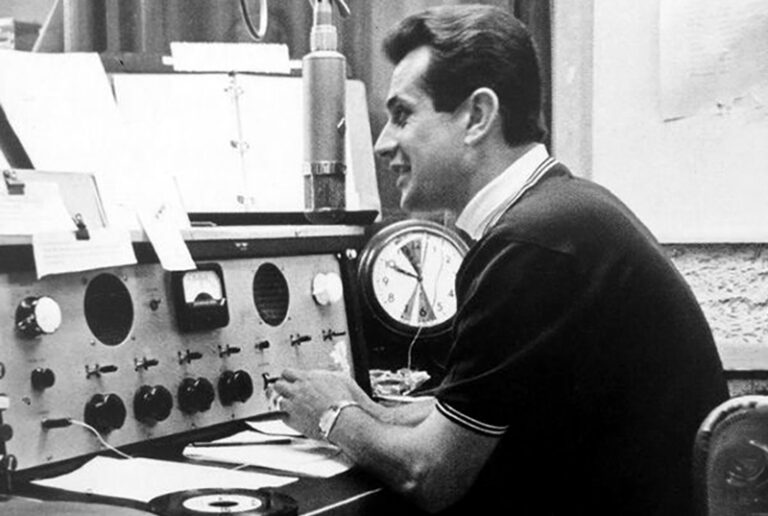
 Speaking no German, Hull faked the words, creating a chaotic comedy routine that became a massive hit with listeners and military brass alike.
 Dave Hull was a central figure in LA’s relationship with The Beatles, and his influence during the British Invasion was unmatched.
 Though Hull is synonymous with KRLA, he was a fixture across the Los Angeles dial for decades, hosting prominent shifts at KFI, KGBS, KMPC, and KHJ.


