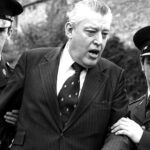
Born Muhammad Abed Ar’ouf Arafat, Yasser Arafat was a Palestinian nationalist politician, cofounder of al-Fatah in 1957, president of the Palestinian Authority, and leader of the Palestine Liberation Organisation (PLO) from 1969.
In the 1970s, Arafat’s activities in pursuit of an independent homeland for Palestinians made him a prominent figure in world politics, but in the 1980s, the growth of factions within the PLO effectively reduced his power.
He was forced to evacuate from Beirut in 1982 following an invasion of Lebanon by Israel. He said at the time, “I am leaving this city, but my heart is here. I am leaving to continue the struggle, so that we can win the war”.
He remained the leader of most of the PLO – who dispersed to Syria, Jordan, Sudan, North and South Yemen, Algeria, Iraq and Tunisia – and, in 1990, persuaded it to formally recognise the state of Israel.
Arafat’s support for Saddam Hussein after Iraq’s invasion of Kuwait in 1990 weakened his international standing, but he was subsequently influential in the Middle East peace talks and, in 1993, reached a historic peace accord of mutual recognition with Israel, under which the Gaza Strip and Jericho were transferred to PLO control.
He returned to the former occupied territories in 1994 as head of an embryonic Palestinian state, and in 1994, Arafat was awarded the Nobel Prize for Peace jointly with Israeli Prime Minister Yitzhak Rabin and Israeli Foreign Minister Shimon Peres.
In 1995, an agreement was reached on further Israeli troop withdrawals from areas in the West Bank, and Arafat took the unprecedented step in October 1995 of inviting the terrorist organisation Hamas to talks on Palestinian self-rule.
In November 1995, Yitzhak Rabin was assassinated by an Israeli extremist, and the peace process appeared to be threatened. Rabin was succeeded by the moderate Shimon Peres, but he lost the 1996 general election and was replaced by the hard-line Likud leader Benjamin Netanyahu.
Despite this, Arafat continued his efforts to achieve lasting peace. He was elected president, with almost 90% of the popular vote, of the self-governing Palestinian National Council in 1996.
In October 1998, the ”Wye agreement” was signed, providing for a further 13% withdrawal of Israeli forces from the West Bank.
In May 1999, Labour candidate Ehud Barak was elected as Israel’s prime minister, and Arafat announced that an independent Palestine state would be declared by the end of the year.
Later that month, Arafat met with King Abdullah of Jordan before the reopening of peace talks with Israel.
In late 2004, after effectively being confined within his Ramallah compound for over two years by the Israeli army, Yasser Arafat became ill, fell into a coma and died on 11 November 2004 at the age of 75.
While the exact cause of his death remains unknown, and no autopsy was performed, his doctors spoke of idiopathic thrombocytopenic purpura and cirrhosis.
The French military Honor Guard held a funeral for Arafat at a military airport near Paris. French President Jacques Chirac stood alone beside Arafat’s body for about ten minutes in a last show of respect for a leader he hailed as “a man of courage”.
Arafat was then flown to Egypt’s capital, Cairo, for another brief military funeral there before his burial in Ramallah. The funeral was attended by several heads of state, prime ministers and foreign ministers.
You May Also Like
Wolfman Jack 1 9 3 9 - 1 9 9 5 With the on-air cool of Alan Freed and the…
Ian Paisley Ian Richard Kyle Paisley was born in Armagh (Northern Ireland), the son of a Baptist minister,…
François Mitterrand 1 9 1 6 - 1 9 9 6 François Mitterrand studied law and politics in…
Barney Bubbles Barney Bubbles is a cult figure among other designers but is barely known outside the field…
Lech Walesa Carpenter's son Lech Walesa grew up in a small village west of Warsaw. While his parents…
Bill Clinton In 1997 the consequences of two alleged sexual misdemeanours coincided in a nightmare scenario for President…
Carlos the Jackal "Carlos the Jackal" was, in fact, Venezuelan-born Ilich Ramirez Sanchez. He was nicknamed 'The Jackal' after…
Boris Yeltsin In 1985 Boris Yeltsin was appointed head of the Moscow City Party Committee. He alienated party…