On the back of his success with the two Beatles‘ movies, A Hard Day’s Night(1964) and Help!(1965), director Richard Lester recruited John Lennon in his first solo acting gig for this wildly surreal satire on war movies.
Lieutenant Ernest Goodbody (Michael Crawford, star of Lester’s The Knack . . . And How to Get It) is a blissfully unaware idiot with absolutely no idea how to lead his British regiment on the North African battlefield of WWII. But what he lacks in experience, he makes up for in gung-ho enthusiasm.
Ordered to build a cricket pitch 100 miles behind enemy lines, the pompous, bumbling officer is determined to succeed even if this means the majority of his small company are killed in the process.
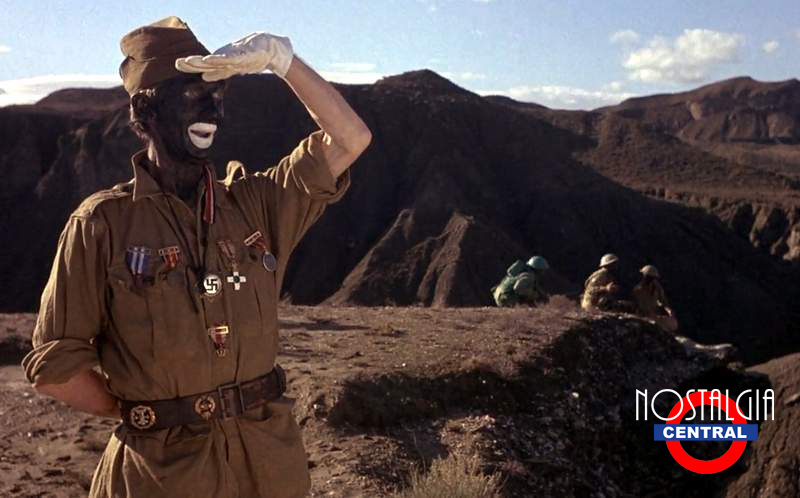
But even those men killed due to Goodbody’s incompetence continue to march along, appearing as monochromatic ghosts.
Abandoned by his superiors, betrayed by his inferiors and finally captured by Nazis, it’s going to take more than his unrelenting optimism to win the day.
Goodbody relates his version of events in flashback to German officer Odlebog (Karl Michael Vogler), whilst the real version of events demonstrates his ineptitude.
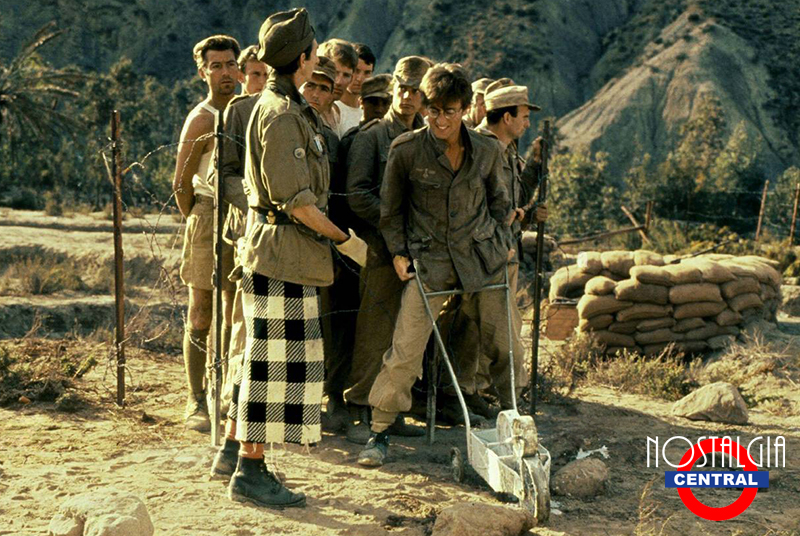
Among the eight-man squad assigned to the Lieutenant are Private Gripweed (Lennon), whose aim in life is to be a faithful officer’s servant and crawling batman; Clapper (Roy Kinnear), whose war-long worry is the wife he left behind; Transom, a professional soldier and the team’s anchorman (Lee Montague); and Juniper (Jack MacGowran), the old soldier of the platoon, always ready to entertain the troops in the most surprising way in any place.
In a surrealistic war, the Musketeers tell the war as they saw it . . . and although set in the 1940s, How I Won The War couldn’t be more 60’s in tone.
It features abrupt time shifts, jump-cutting, characters breaking off to address the camera directly and Lester’s patented brand of biting slapstick humour.
Shot on a tight budget of £400,000 between early September and early November 1966, How I Won the War marked the first symbolic sighting of solo John Lennon: short-haired and bespectacled, wiry and sneery, taking potshots at the Establishment.
Lester insisted it wasn’t an anti-war film, but an anti-war film-film, against the glorification of war, though they still had to borrow and steal all the military hardware in the film because they couldn’t let anybody see the script.
In Germany, Lester managed to borrow three tanks from the British Rhine Army, though the film’s psychedelic colour scheme confused NATO top brass. When a baffled tank commander enquired what the hell this rainbow-hued platoon signified, Lester’s quick-thinking associate producer Denis O’Dell explained they were “colour tests for Technicolor”.
Genius. The tanks stayed in the picture.
Released in October 1967, the film was poorly received. Angry MPs and ex-servicemen’s organisations condemned the irreverent use of Field Marshal Montgomery’s speeches and genuine battle newsreel footage, and two big UK cinema chains refused to show the film.
Scuffles broke out during the film’s opening run at the Pavilion in London, and the National Front threw stink bombs in the audience.
Savage and surreal, How I Won the War remains one of the first films to apply angry absurdism to sacred cows like Churchill and Montgomery. It’s a strikingly sour and ambitious product of its times.
John Lennon never took another dramatic role.
Two days after his return from location shooting, on 9 November 1966, he met Yoko Ono for the first time at the Indica Gallery in London.
By the time the film was released, Brian Epstein was dead, Sgt Pepper had turned The Beatles into psychedelic pop gods, and the ill-fated Magical Mystery Tour film was sinking into monstrous self-indulgence.
Movie stardom no longer figured in Lennon’s post-Fabs escape plan.
Lt Ernest Goodbody Michael Crawford
Gripweed
John Lennon
Clapper
Roy Kinnear
Juniper
Jack MacGowran
Transom
Lee Montague
Lt Col Grapple
Michael Hordern
Melancholy Musketeer
Jack Hedley
Spool
Ronald Lacey
Odlebog
Karl Michel Vogler
Drogue
James Cossins
Dooley
Ewan Hooper
Director
Richard Lester
Video
You May Also Like
Halloween II (1981) It is still Halloween night 1978, and Laurie Strode (Jamie Lee Curtis) is in Haddonfield Hospital…
Clockwise (1986) Brian Stimpson (John Cleese) is the punctilious and highly disciplined headmaster of a Gloucestershire comprehensive school…
Part Time Wife (1961) Struggling insurance salesman Tom Briggs (a young Anton Rodgers) tries to drum up some business with…
In The Heat Of The Night (1967) "They call me Mister Tibbs". While travelling in the Deep South, Virgil Tibbs (Sidney Poitier), a…
Dracula AD 1972 (1972) This ill-conceived attempt at updating Dracula sees the vampire (once again played by Christopher Lee) materialise…
Krays, The (1990) Gary and Martin Kemp of Spandau Ballet starred in this account of Ronnie and Reggie Kray - the…
Hello, Dolly! (1969) Dolly Levi (Barbra Streisand) is a highly regarded professional matchmaker at the turn of the 19th…
Cruel Sea, The (1953) The story follows the Royal Navy Flower-class corvette HMS Compass Rose under Captain George Ericson (Jack…


 Ordered to build a cricket pitch 100 miles behind enemy lines, the pompous, bumbling officer is determined to succeed even if this means the majority of his small company are killed in the process.
 Among the eight-man squad assigned to the Lieutenant are Private Gripweed (Lennon), whose aim in life is to be a faithful officer’s servant and crawling batman; Clapper (Roy Kinnear), whose war-long worry is the wife he left behind; Transom, a professional soldier and the team’s anchorman (Lee Montague); and Juniper (Jack MacGowran), the old soldier of the platoon, always ready to entertain the troops in the most surprising way in any place.
 John Lennon never took another dramatic role.


