Former British Formula 3 racing champion Harry Stiller owned four acres of land in Christchurch, Dorset, which had originally housed a golf school. He converted the site into a pub and a golf and leisure park and wanted to include a rollercoaster, but he could not obtain planning permission.
Taking inspiration from the Madurodam (a miniature tourist attraction in the Netherlands), he decided to build the “greatest model Britain in the world”.
Model villages had long been popular in Britain, and several existed already, especially at seaside resorts. But “Tucktonia” was something else.
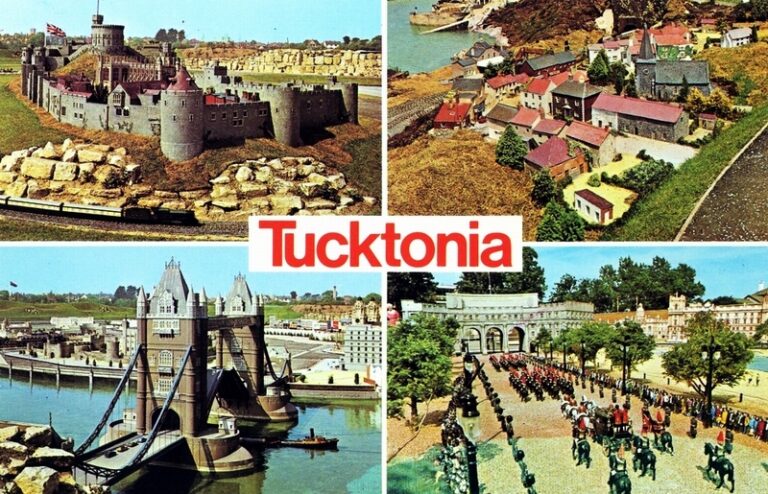
Here, you could see not just houses but iconic British features such as Stonehenge, Buckingham Palace, Windsor Castle, Hadrian’s Wall and the Cenotaph – all built to a much larger scale (1:24) than usually used in model villages. St Paul’s Cathedral, for example, was 16 feet high.
There were motorways, a floating oil rig, a railway, an airport, and a modern dockland complex.
One section of Tucktonia depicted a typical seaside resort complete with a pier, station, and seafront trams. A superb replica of the QE2 luxury liner was moored alongside the pier. Another area contained a Cornish fishing village with a sheltered harbour, and pink cottages tiered on the cliffs.
There were farm buildings and oast houses, a nuclear power station, a motorway service station, a windmill, and a watermill. Other models depicted cricket and football matches, castles and ruins. Scotland was represented, too, with Burns’ Cottage, the Burns Memorial and a model of the Highland Games in progress.
A whole section was devoted to London, with St Paul’s Cathedral, Buckingham Palace, the Tower of London, Westminster Abbey, the National Gallery, Admiralty Arch, Piccadilly Circus (complete with advertising hoardings and the statue of Eros), the Houses of Parliament and Trafalgar Square.
Even the Post Office Tower was there. The 26-foot high model had to be lowered into position by army helicopter in 1978 as there was no other easy access, so crowded was the site with models.
Red London double-decker buses and black taxis abounded while barges hauled their loads along a stretch of the River Thames past the Embankment, Cleopatra’s Needle, the Sphinx and the Discovery moored nearby. A royal procession was in progress in the Mall, and mounted guards with plumed helmets could be seen on Horse Guards Parade.
Charing Cross Hotel at Charing Cross Station was depicted, as well as a typical modern high street complete with shops and chain stores.
In complete contrast was a section devoted to early London, where you could see the original London Bridge with houses adorning its arches and piers, and the Globe Theatre (if you looked through the open roof, you could see the tiny actors on the stage and the audience too).
The displays were not all static – Concorde and Jumbo Jets taxied around the airport, ships moved across the harbour, cars drove along the motorway, and Gauge 3 scale trains travelled almost half a mile of track.
A North Sea oil rig would suddenly burst into flames, and boats equipped with hoses would extinguish the fire. Tower Bridge would raise its bascules to allow ships to pass beneath, and the restaurant at the top of the Post Office Tower revolved, just as in real life.
The model-making contract had been awarded to Bournemouth company KLF Ltd, but work was subcontracted to dozens of other companies across the UK.
The buildings and features were constructed from fibreglass, steel, and wood, and thousands of 3-inch-tall people brought them to life.
The miniature docks and waterways required 164,000 gallons of water, and more than 12,000 bulbs lit the site at night.
The village was reputed to have cost £2m to build and, on 23 May 1976, it was officially opened by comedian Arthur Askey.
Other activities at the site included a 9-hole golf course, go-karts, dodgems, a 35-foot-high six-lane giant slide, mini motorcycles, a ghost ride, bumper boats, a slot-car racing track, a bouncy castle, a ride-on steam train, an amusement arcade, a gift shop, a cafe, and a pub.
Keith Chegwin and Maggie Philbin hosted an edition of Swap Shop from the park, and famous visitors included Tommy Cooper, Jon Pertwee (in character as Worzel Gummidge) and Una Stubbs.
Tucktonia also appeared in the long-forgotten 1976 spoof film Queen Kong. Later, it was used to stage the alien destruction of London in Tobe Hooper’s 1985 sci-fi horror film Lifeforce.
Sadly, the life of Tucktonia was short. It thrived for three years, but then, in 1979, Thorpe Park Resort opened near Chertsey in Surrey, followed a year later by Alton Towers near Stoke-on-Trent in Staffordshire.
Soon, people turned away from Tucktonia, thinking it old-fashioned alongside the new giant theme parks.
After changing hands several times, plans were approved for a £10m housing and leisure complex on the site, with Tucktonia due to move to another location. But in 1986, it closed to the disappointment of many.
The site was cleared, and Costain Homes developed it for a 130-home residential development known as The Meridians.
The model buildings were stored on the Ebblake industrial estate in Verwood.
Tragically, the entire collection (except the 22-foot model of Buckingham Palace) was destroyed in a fire in October 1990.
That sole remaining model can now be viewed at Merrivale Model Village, located on the seafront at Great Yarmouth, Norfolk.


 Taking inspiration from the Madurodam (a miniature tourist attraction in the Netherlands), he decided to build the “greatest model Britain in the world”.


 Charing Cross Hotel at Charing Cross Station was depicted, as well as a typical modern high street complete with shops and chain stores.

 Keith Chegwin and Maggie Philbin hosted an edition of Swap Shop from the park, and famous visitors included Tommy Cooper, Jon Pertwee (in character as Worzel Gummidge) and Una Stubbs.
 The site was cleared, and Costain Homes developed it for a 130-home residential development known as The Meridians.


