Joe Orton (pictured below right) was one of the brightest lights in London’s luminous theatre district during the 1960s.
His first full-length play, Entertaining Mr Sloane, sold to television and the movies. The second, Loot, was voted best play of the 1966 season and sold to the movies. Orton’s third, final, and finest work, What The Butler Saw, was completed and ready to go into production by the time he was 34.
Orton’s outrageous parodies of bourgeois sensibility fit perfectly with the era’s anti-establishment mood. So it really wasn’t all that surprising when Paul McCartney contacted Orton in January 1967 to ask the brilliant young playwright to write the screenplay for The Beatles‘ third movie, the intended follow-up to Help! (1965).
Over dinner at Brian Epstein‘s home a couple of weeks later, McCartney told Orton that Loot was the only play he had ever enjoyed.
“All I normally get from the theatre,” McCartney told Orton, “is a sore arse.”
The only cloud on Orton’s horizon was his tempestuous 16-year relationship with Kenneth Halliwell, a large fellow with the frazzled nerves of a Cockney housewife.
Halliwell – a fellow writer Orton described as a “middle-aged mediocrity ” – not only resented Orton’s professional success and constant ridiculing, but also his compulsive promiscuity, which often took the form of homosexual orgies in public lavatories.
During their 1967 holiday in Tangier (pictured below left), Orton taunted Halliwell by seducing young Arab boys in back streets.
Halliwell’s jealousy was compounded by Orton’s inability to consummate their relationship.
“I can fuck other people perfectly well. But up to now, I can’t fuck you,” wrote Orton in his diary when recounting a conversation with Halliwell after a failed sexual encounter.
Despite his frequent physical and verbal battles with Halliwell and the incessant carrying on in public toilets, Orton somehow found the time and energy to finish the first draft of Up Against It for The Beatles, which he delivered to Brian Epstein‘s office in July 1967.
The Beatles and Epstein ultimately rejected the script due to its highly risqué, anarchic, and overtly homoerotic themes.
A peeved Joe Orton wrote in his diary at the time: “No criticism of the script. And apparently, Brian Epstein had no comment to make either.”
A few weeks later, Orton lay dead in his miserable little apartment, with his skull smashed in from nine hammer blows delivered by an angered Halliwell, who in turn had killed himself with a massive overdose of Nembutals.
Brian Epstein’s death from a drug overdose eighteen days later – and the ensuing chaos within the Beatles organisation – destroyed remaining hopes for a Beatles movie based on a Joe Orton screenplay.
The project lay dormant for almost 20 years until Tom Ross, Musical Projects Director of New York’s Shakespeare Festival, discovered a copy of Up Against It in 1985.
He immediately brought the script to the attention of Joseph Papp, the producer of the Shakespeare Festival and the person responsible for bringing musicals like A Chorus Line, The Pirates of Penzance and The Mystery of Edwin Drood to off-Broadway, Broadway, and movie audiences.
Orton’s outrageous farces had largely been ignored in the US until the 1986 New York production of Loot became one of the only successes of the Broadway season. Sensing that Up Against It might appeal to the same audiences, Papp optioned the screenplay from Orton’s estate.
Up Against It is a fascinating look at Orton’s scurrilous mind at work.
In the play, society has been turned upside down.
Three lads leave their tiny village to make it in the big city, only to find that tweed-suited women hold all the major offices, including the Archbishop of Canterbury and the commander-in-chief of the army.
A furious battle ot the sexes is soon underway, and the lads – originally to be played by the Fab Four – are caught in the middle.
Bourgeoisie notions of sexuality are continually turned on their heads, such as in the scene where a desperately horny police chief in a skintight black uniform hurls an astonished “Beatle” onto a bed as she yells, “Quite a little sweetheart, aren’t you? You need someone to look after you!”
As more and more people join the free-for-all beneath the sheets, the scene turns into a typically Orton-esque example of sexual excess.
The immediate problem facing Papp and Ross was finding someone suitable to write the music for the unusual show. Orton’s bizarre vision of a topsy-turvy society was written to be performed around the music of Lennon and McCartney.
“In spite of Orton’s brilliance,” said Ross, “there was something missing without any music.”
Around the same time Papp optioned Up Against It for the Shakespeare Festival, Todd Rundgren‘s manager was putting the word out in theatre circles that his client was very interested in writing music for the stage.
When Ross heard that Rundgren (pictured at right) wanted to try his hand at musicals, he immediately tried to convince Papp that the synth-whiz was “a natural for the theatre” by playing his boss Rundgren’s interpretation of a Kurt Weill song from the 1985 Lost In The Stars album, a tribute to Weill.
Rundgren got the job.
Ross was a long-time admirer of Rundgren’s work and gave him virtual free rein in his approach to the score for Up Against It. Given his brilliant, unpredictable career, it isn’t surprising that Rundgren chose an unexpected approach to the music.
He didn’t change the dialogue or introduce new characters, but the music now didn’t emphasise things that weren’t in the script, as they would have done if The Beatles had been involved.
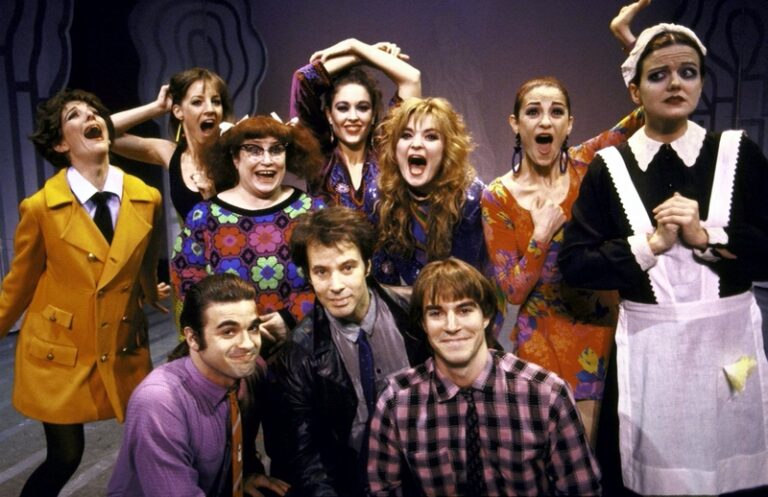
Rundgren wrote the music and lyrics for 15 songs, and the production ran at the Public Theater in Greenwich Village in November and December 1989, directed by John Wishnak.
Dan Tubb played Jack Ramsay (the role that would have been reserved for John Lennon in the proposed movie version), Philip Casnoff played Ian McTurk (the Paul McCartney role), and Roger Bart – who would later win a Tony for You’re a Good Man, Charlie Brown – played Christopher Low (the Ringo role).
New York Shakespeare Festival’s production of “Up Against It.” Public Theater, New York. November 1989.
Joe Orton eliminated the George Harrison role after The Beatles had turned down the script.
Alison Fraser played Miss Drumgoole, the parlourmaid who adored McTurk but whose love remained unrequited until the finale. Toni DiBuono was a strident Chief of Police; Judith Cohen played “The Man in the Hole” and Lilly Corbett; and Mari Nelson played a bimbo.
Todd Rundgren’s score was highly praised and remains a cult favourite among his fans.
Because the musical failed to secure a wider Broadway run and no official Off-Broadway cast recording was released at the time, Rundgren eventually recorded and released his own versions of the entire score on his 1997 album, Up Against It.
Ian McTurk
Philip Casnoff Jack Ramsay
Dan Tubb Christopher Low
Roger Bart Miss Drumgoole
Alison Fraser The Mayor
Joel McKinnon Miller Father Brodie/The Old Man
Stephen Temperley Connie Boon
Toni DiBuono Rowena
Mari Nelson Bernard Coates
Tom Aulino The Man in the Hole/Lilly Corbett
Judith Cohen Georgina
Marnie Carmichael Guard
Scott Carollo Ensemble
Brian Arsenault
Scott Carollo
Mindy Cooper
Dorothy R. Earle
Julia C. Hughes
Gary Mendelson
Jim Newman
You May Also Like
Hessy's Music Centre (Liverpool) For decades, Liverpudlian music lovers would head to Hessy's Music Centre (known locally simply as "Hessy's")…
Argonauts Club, The (1941 - 1972) Fifty mighty Argonauts, bending to the oars Today will go adventuring to yet uncharted shores Fifty…
Compleat Beatles, The (1982) The story of the most famous group in the history of popular music, narrated by Malcolm…
Help! (1965) Fresh from the success of A Hard Day's Night, The Beatles had the world at their feet…
Beatles, The So it goes like this . . . 15-year-old Paul McCartney hears a Skiffle group called The Quarrymen play on…
The Juke Box Jury Hot Seat A pretty girl singer sat smiling as her record was played. Feet owned by teenage fans…
Yellow Submarine (1968) The Beatles come to the rescue when the evil Blue Meanies try to drive all the…


 Orton’s outrageous parodies of bourgeois sensibility fit perfectly with the era’s anti-establishment mood. So it really wasn’t all that surprising when Paul McCartney contacted Orton in January 1967 to ask the brilliant young playwright to write the screenplay for The Beatles‘ third movie, the intended follow-up to Help! (1965).
 Halliwell’s jealousy was compounded by Orton’s inability to consummate their relationship.
 Brian Epstein’s death from a drug overdose eighteen days later – and the ensuing chaos within the Beatles organisation – destroyed remaining hopes for a Beatles movie based on a Joe Orton screenplay.
 In the play, society has been turned upside down.
 Around the same time Papp optioned Up Against It for the Shakespeare Festival, Todd Rundgren‘s manager was putting the word out in theatre circles that his client was very interested in writing music for the stage.

 Todd Rundgren’s score was highly praised and remains a cult favourite among his fans.


