This two-part BBC series starred Julia Foster as Daniel Defoe’s famous (fictional) singularly indestructible bed-hopping 17th-century woman who was “12 years a whore, five times a wife.”
Betty (Moll’s real name) is born in Newgate Prison and abandoned in Colchester as an orphan. As a young girl, she is befriended by the aristocratic Lady Verney (Diana Fairfax) and becomes a servant in her house.
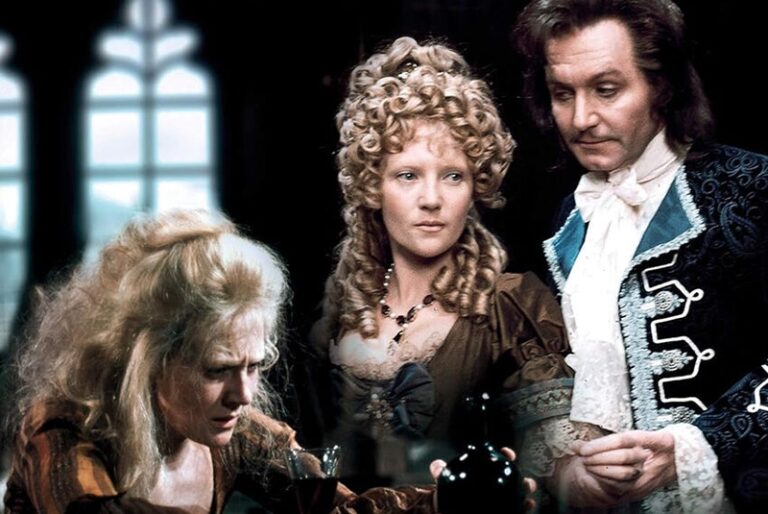
There, she is seduced by the rascally older Verney son, Edward (Jeremy Clyde), but eventually marries his considerate but dull younger brother, Robin (Paul Lavers).
Following Robin’s death, she moves to London, where she eventually marries her “gentleman-tradesman” spendthrift husband, Henry Haydock (David Bentley), who goes bankrupt and flees to mainland Europe, leaving her on her own to escape the bailiffs with little more than the clothes on her back.
Fortunately, she soon meets and marries prosperous plantation owner Humphrey Oliver (Ian Ogilvy) and returns with him to Virginia in the colonies, where she discovers from Humphrey’s mother (Madge Ryan) that he is, in fact, her own half-brother. Distraught, she dissolves their marriage and returns home, leaving her two children behind.
Back in England, she is virtually penniless and forced to support herself through a series of mercenary affairs. She becomes the mistress of old hypochondriac Thomas (Patrick Newell), who, as a “slave to ill health”, cherishes only sympathy as a puzzled Betty shares his virginal bed. He turns out to be – how shall we say – surprisingly virile, but ultimately dumps her.
In Liverpool, Betty meets handsome highwayman Jemmy Earle (Kenneth Haigh). She thinks he has property in Ireland. He thinks she’s the monied love child of a Duke. When they discover the truth, they part company to seek their fortunes individually.
Betty subsequently marries dull and frugal (but loving) bank clerk William Stubbs (Barry Jackson) but is left destitute after his death.
The ever-resilient Betty turns to a life of prostitution and thievery (earning the name “Moll” Flanders), which brings her the financial security she has always sought but ultimately takes her full circle back to Newgate Prison.
In prison, she is reunited with Jemmy Earle and repents just as eternity looms, only a dangling drop away.
The final period of her life finds Betty as a serene grandmother, now happily married to Jemmy and living back in Virginia, with a thriving tobacco plantation inherited from her mother, Mrs Oliver.
Through the magic of makeup and her own talent, Julia Foster ages perceptibly and believably during the four-hour dramatisation, changing from a voluptuous teenager to a battle-scarred crone. The changes include subtle touches – the cracking voice, the cast of eye, the carriage.
Karin MacCarthy as Meg, Moll’s longtime confidante and a career prostitute, and Maureen Pryor – the crafty fence Mrs Gill, who teaches Moll how to be a thief – shine in their roles.
A singing group called The Watersons punctuates the proceedings with traditional bawdy ballads such as Seeds of Love, Fair Rosamund and Throw Your Leg Over.
Hugh Whitemore adapted the series from the famous novel by Defoe, capturing much of the novel’s bawdy and raucous elements. An edited version of the series aired on PBS in the US over two nights in 1979.
Betty/Moll Flanders
Julia Foster Meg
Karin MacCarthy Thomas
Patrick Newell Robin Verney
Paul Lavers Humphrey Oliver
Ian Oglivy Henry Haydock
David Bentley Catherine
Lynne Jones Jemmy Earle
Kenneth Haigh Lady Verney
Diana Fairfax Edward Verney
Jeremy Clyde Jenny
Sheila Reid William Stubbs
Barry Jackson Mrs Oliver
Madge Ryan Mrs Gill
Maureen Pryor Balladeers
The Watersons
You May Also Like
Mr Broadway 1 9 6 4 (USA) 13 x 60 minute episodes Mike Bell (Craig Stevens), was a sophisticated…


 There, she is seduced by the rascally older Verney son, Edward (Jeremy Clyde), but eventually marries his considerate but dull younger brother, Robin (Paul Lavers).
 The ever-resilient Betty turns to a life of prostitution and thievery (earning the name “Moll” Flanders), which brings her the financial security she has always sought but ultimately takes her full circle back to Newgate Prison.


